


What if, the next time a major disinformation campaign struck the UK, a civilian reserve force sprang into action. Trained people, looking for a way to give back, would gather to verify claims and share trusted information (with a public that’s grown increasingly sceptical of institutions and is more likely to trust fellow citizens). What if, at the same time, researchers and computer scientists deployed to lend a hand in killing foreign-manufactured lies before they confuse and sow division.
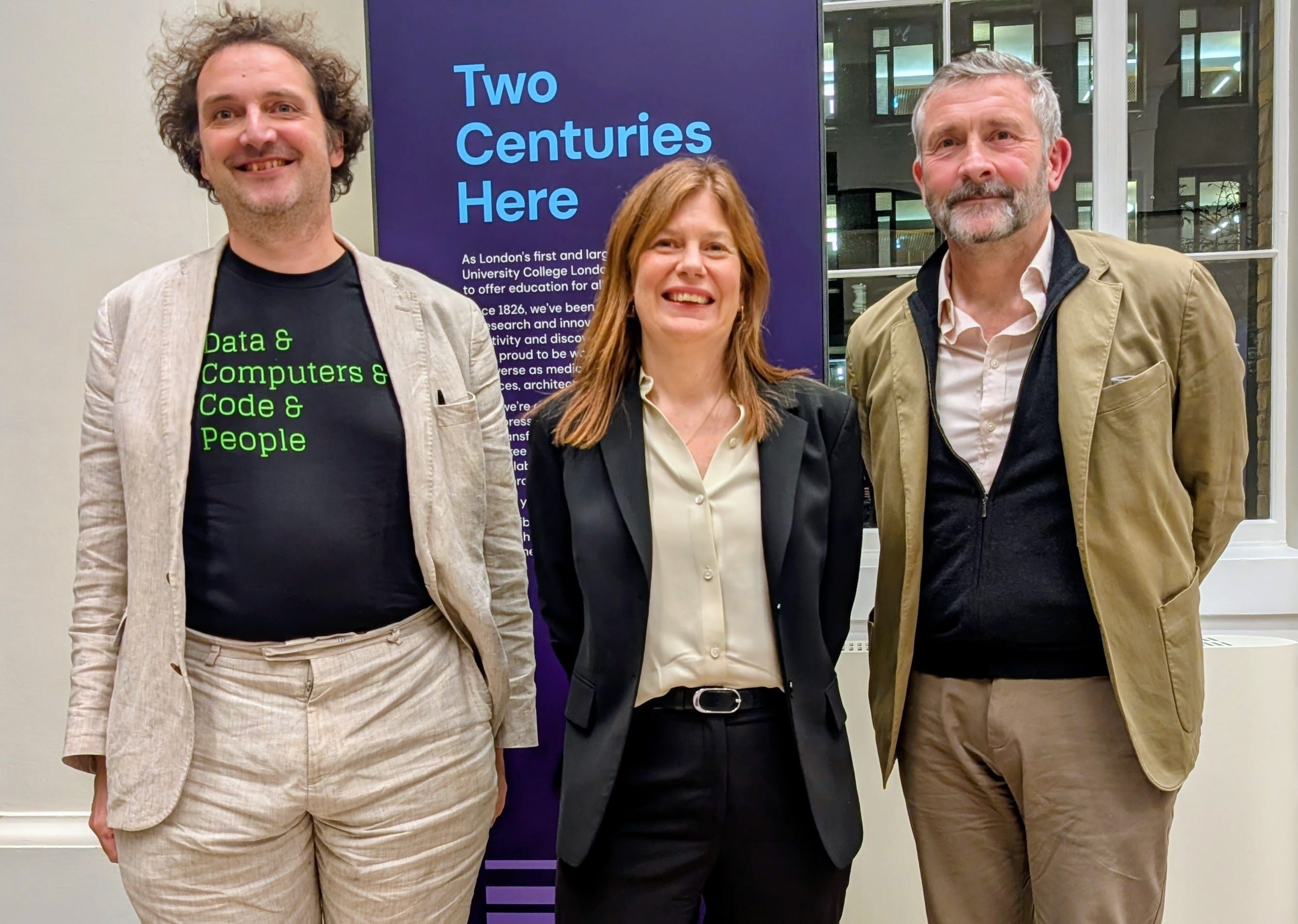
This was one of the compelling ideas discussed at the latest Athena panel, which brought together a military strategist and a professor leading UCL’s Grand Challenge of Data Empowered Societies programme. Athena has partnered with UCL to host a series of conversations aimed at finding solutions to the challenges disinformation brings.
Despite the immense technical complexity behind the latest AI developments, the solutions discussed at the London event on Tuesday turned out to be largely societal and cultural. Speed, collaboration, and sovereign models emerged as key responses.
James Hetherington, Professor of Computational Science and Academic Director of UCL’s Advanced Research Computing Centre, set the scene. He spoke about agentic AI (AI models running complex disinformation campaigns), LLM grooming, and the implications of AI improving itself (recursive self-improvement). For Hetherington, the profound change is that computers can now work with human language in ways that reach directly into how we think and understand the world - a change from expressing themselves only in numbers, which happened about six years ago.
“Language is how we reflect, observe and discuss,” said Hetherington. “So the fact that language has become part of computer science is mildly terrifying.”
Ripping it apart
Air Marshal Edward Stringer, a retired RAF jet pilot and former director of Military Operations at the MOD, agreed, adding that adversaries are not interested in specific election outcomes - the deeper motive is to confuse and divide, using ever faster AI tools. The true aim, he said, citing past elections in the US and Romania, is to “rip apart” society on key issues and to reinforce fears.
“The new bit is finding a new way to attack the credibility of your institutions, which is a route to polarisation,” Stringer explained. “You can’t make people believe things they don’t want to think. But if they’ve got secret fears or they’re actually halfway to thinking, ‘That’s all rubbish,’ you just reinforce it.”
A key topic on the night was speed: how defenders can prepare and anticipate fast-moving attacks powered by the latest AI.
Stringer spoke about military procurement, plagued by long contracts and restrictive specifications. In his view, we are now on a “virtual battlefield” where defences need to be built and tested quickly, as they are on the frontlines in Ukraine.
“You need to be able to move quickly, you need to be able to be agile, you need to be able to move with people who can move quickly,” he said. “We have to learn how to be an intelligent customer with the sort of companies we rely on to generate the products we need as the whole battle space changes around us.”
Hetherington added that despite being responsible for innovation, universities have processes that slow it down. Change, whether in the military or in academia, means evolving ways of working and developing industry partnerships.
Ready to rally
Partnerships can extend to building a civilian reserve to bolster a nation’s information resilience. Stringer’s argument is that, despite being polarised, people tend to trust their peers more than state agencies. Such a reserve could train and exercise together, and stand ready to mobilise. Drawing on his experience in advising government during the pandemic, Hetherington warned that bureaucracy should not delay bringing researchers into the national response.
Linked to this, Hetherington said the UK and its European allies need to build and train their own AI models. Developing sovereign models, he believes, helps a nation maintain control and build public trust. To do that, they’ll need to invest in the expertise and computing resources, and forge stronger relationships with frontier labs. Defenders, Hetherington argues, need to be able to inspect and experiment with models, building public trust through open-source development and transparent data.
For Stringer, trust extends to developing tools that frontline defenders actually need, throwing out the “glossy box and packaging” if need be. He spoke about the mismatch between expensive, highly engineered battlefield equipment and what lands up being practical, affordable and useful. He warned that new products integrated into old systems lead to slow change - the kind we can’t afford.
Two cheers for new disinformation centre
Speaking of new and old… Stringer gave “two cheers” for Britain’s plans to set up a new centre (the National Centre for Information Defence) to combat hostile disinformation attacks. He was holding onto the third cheer, he said, until there’s a clearer mandate and more information on how the centre will avoid policing ordinary political discourse or drifting into its own political messaging. Stringer said Sweden offers a useful template for focusing on genuine external interference and setting itself high thresholds for intervention. Stringer questioned how overlapping responsibilities will be managed between the new centre and various older agencies and government departments.
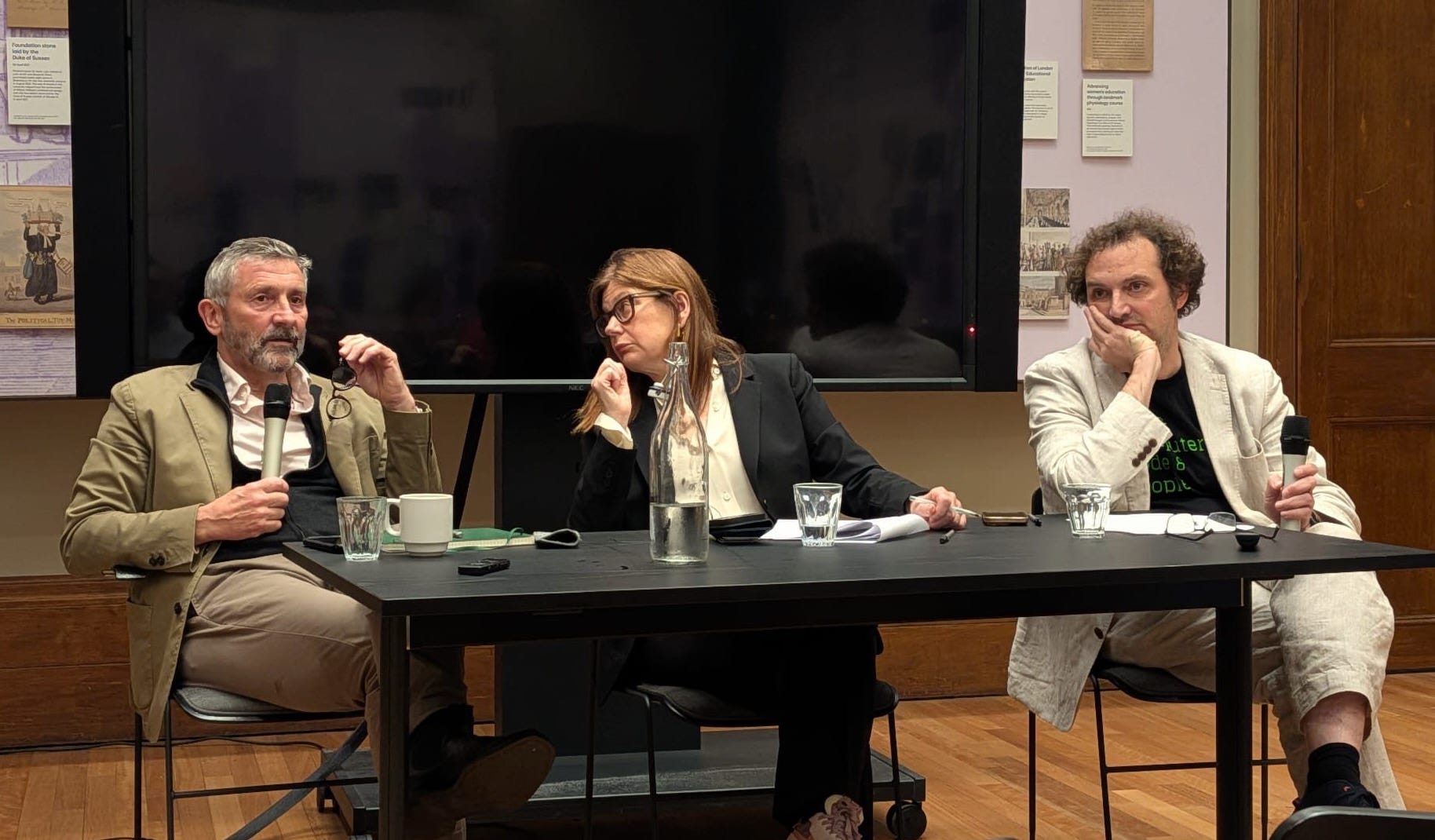
The experts agreed that AI is evolving at an astonishing speed. The “virtual battlefield” has changed completely (“the internet we wanted is not the internet we got” says Hetherington). And, to quote Stringer, “all wars are wars of force development”, the information war included.
Building a standing defence means uniting citizens, researchers, industry and government - and enabling them to move quickly, develop and adapt the tools they need.
Analysis: work together, democratise defence
When it comes to defending against AI-powered disinformation, everyone has a role to play.
In this short video, Athena’s Jessica Cecil reflects on her conversation with UCL Professor James Hetherington and Air Marshal Edward Stringer, who believe that despite the technical complexity behind the attacks, collaboration can help build effective defences.
As Jessica explains, this collaboration plays out at all levels, from the scientific to the societal:
Bugs and eyeballs: why universities need to be in the trenches of information warfare
In open-source software engineering, a “shallow bug” is a problem that’s easy to spot. A “deep bug” is a hidden fault that needs investigating. Put enough people to work examining the code, and both types of bugs can be fixed.
There’s even a neat phrase for it: “Many eyeballs make all bugs shallow”.
Professor James Hetherington thinks this idea has something to offer those defending the information space.
“If our information theatre is itself constructed of software, which is now the case, then this applies,” he told Athena.
His point: defending the systems through which we discover and share knowledge needs more people with the right tools.
Bringing more eyes to the problem
At UCL, that means bringing computer scientists and engineers into closer partnership with historians, legal scholars and education researchers. Understanding how a technology works is one part of the defence. Understanding why people believe what it produces is another.
The university’s Data Empowered Societies Grand Challenge is creating a Disinformation Hub to connect these perspectives. The work has three strands: developing a research centre, exploring education on disinformation, and examining case studies.
The research involves asking what makes people susceptible to manipulation.
“What is it about the world that’s underpinning people’s likelihood to believe or accept disinformation?” asked Melanie Smallman, UCL’s Professor of Science and Technology Studies leading the development of the Disinformation Hub. “We can then pass on that basic knowledge to people and policymakers who will make really good use of it.”
Technology that serves people
The Disinformation Hub sits within the wider programme, launched in late 2024. Data Empowered Societies brings researchers from across UCL together to explore how data and technology can help people overcome challenges, taking into consideration their needs and vulnerabilities.
For Hetherington, the opportunity extends to building language models whose origins can be examined. Greater transparency could give researchers and civil society more ways to scrutinise the systems shaping our knowledge.
The ambition is to turn collective expertise into collective capability: more people able to understand the information reaching them, challenge its origins and help repair the weaknesses attackers exploit. Enough eyes, better tools, and those bugs may just become shallower.

News: what changed this week
“We can’t legislate our way out of any harm,” says Britain’s democracy minister. Florence Eshalomi told MPs on Tuesday that defending elections requires regulation that adapts to fast-changing online threats, alongside greater responsibility from social media companies. She called for platforms to work with government to keep elections free from foreign interference. For disinformation defenders, the challenge is keeping practical safeguards moving as quickly as the tools used to attack them.
Taiwan warns of a surge in Chinese disinformation ahead of local elections. Its National Security Bureau says it tracked more than 2.5 million pieces of disputed or false information originating from China in the first nine months of 2026 - up 48% on a year earlier. According to Reuters, the bureau describes a mix of AI-generated videos, fake accounts and coordinated comment flooding aimed at sowing division and influencing November’s vote.
Fake celebrities, inflated audiences: an influence operation manufactures both credibility and engagement. Bloomberg reports that Russian operation Matryoshka is using AI-generated videos impersonating stars including Robert De Niro and Julia Roberts to attack Democrats ahead of the US midterms, with bots inflating view counts.
Read Bloomberg’s investigation
Microsoft targets the businesses behind a billion malicious messages. Working with international partners, Microsoft disrupted three criminal services supplying accounts and tools for impersonation scams. It says the services targeted over 75,000 organisations in more than 150 countries. Court-authorised domain seizures and account closures show how defenders can dismantle the infrastructure behind deception.
Solutions:
Asked where useful solutions are emerging, James Hetherington pointed to efforts to make AI more transparent, adaptable and open to scrutiny. Here are his picks, alongside the disinformation research taking shape at UCL:
UCL is bringing together computer scientists, engineers, social scientists and humanities researchers through its Grand Challenge of Data Empowered Societies. Its Disinformation Hub is investigating why people accept disinformation to give defenders and policymakers stronger evidence to work with. Hetherington also highlighted UK-LLM/BritLLM, UCL’s work to develop sovereign, open-source language models aligned with UK needs.
Open Athena is a nonprofit helping academic researchers build and adapt AI models openly. Its Marin project shares code, training-data sources, tools, and the outcomes of its experiments. That allows researchers to inspect how models are built, test their weaknesses and develop alternatives.
Honourable mention:
Hetherington highlighted Bluesky and its AT Protocol, which allow users to choose or build feeds, giving them more control over how (and what) information reaches them. “In the current media,” he said. “Algorithm is editorial.”